Coconut husk fibres are used for mats which are tough and fibrous. Which tissue has structural features suitable for providing this strength? Explain why living parenchyma couldn’t serve the same purpose.
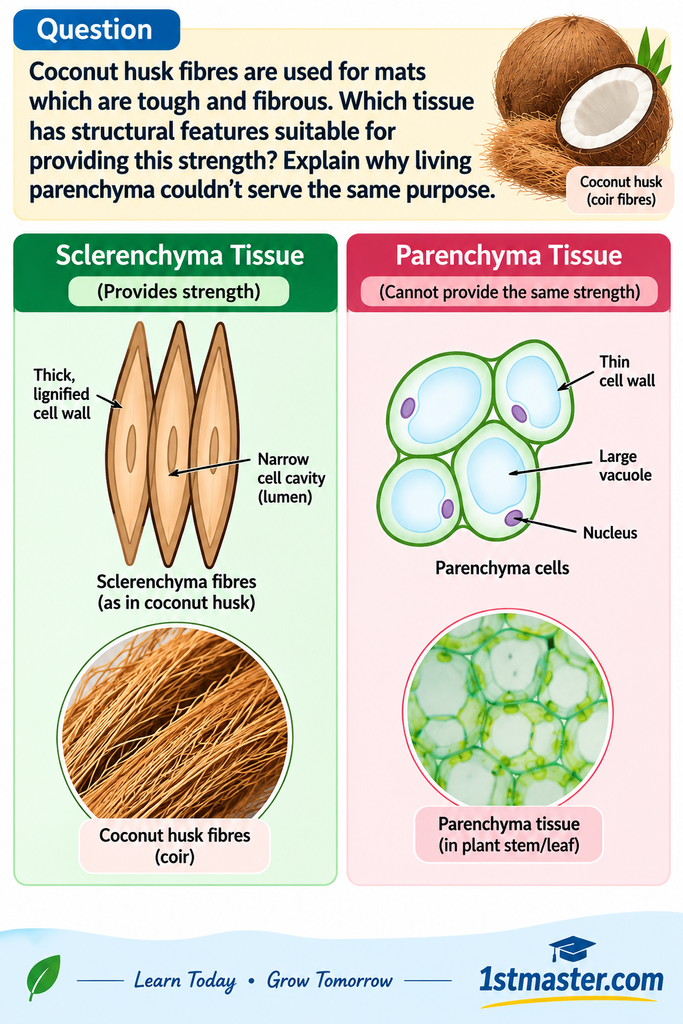
The tissue providing strength to coconut husk fibres is sclerenchyma.
The cells of sclerenchyma have thick and rigid cell walls containing a substance known as lignin. The cells are dead on maturity and provide mechanical support and strength to the plants. Hence, fibres obtained from coconut husk are strong and can be used to make mats, ropes and brushes.
Living parenchyma cells cannot provide similar strength due to their thin and tender cell walls.
Parenchyma cells mainly perform storage functions and photosynthesis. Thus, they do not possess sufficient strength to form fibres like sclerenchyma.
In Brief: Sclerenchyma → thick, lignified walls → strong and tough; Parenchyma → thin walls → soft and mainly for storage/photosynthesis.