Answer
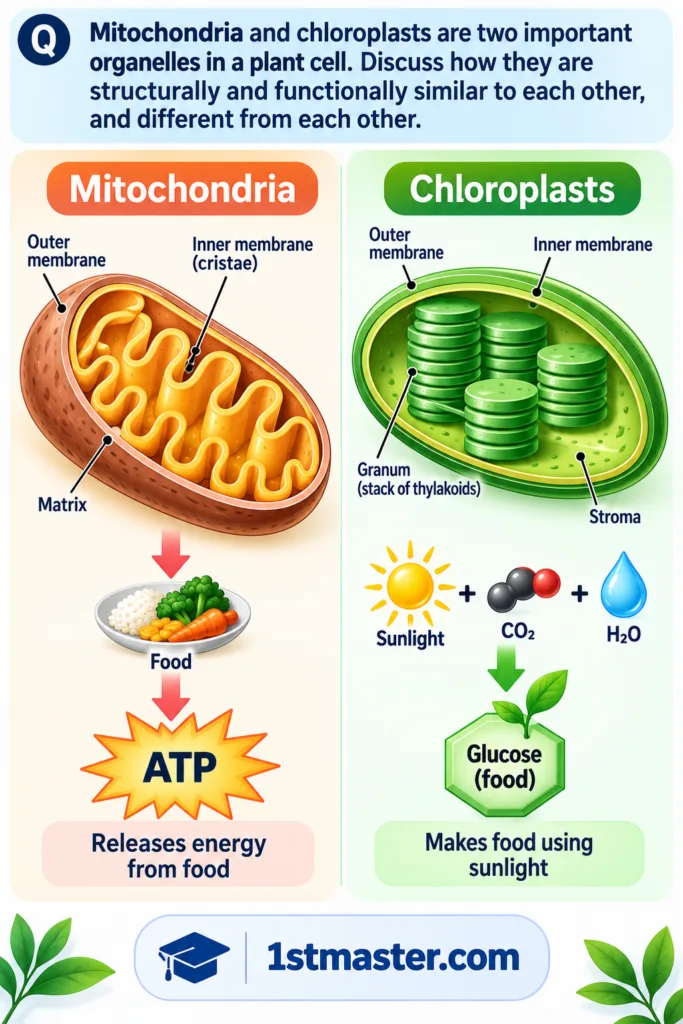
Both mitochondria and chloroplasts are double membrane-bound organelles and it contain their own DNA and ribosomes. Both are involved in energy conversion. Mitochondria have cristae but chloroplasts contain chlorophyll.
Mitochondria release energy from food or glucose through cellular respiration, while chloroplasts make foods by photosynthesis and Store energy in the form of glucose .
Explnation:
Similarities between Mitochondria and Chloroplasts
| Point | Similarity |
|---|---|
| 1. Membrane | Both are surrounded by a double membrane. |
| 2. DNA | Both contain their own DNA. |
| 3. Ribosomes | Both contain ribosomes. |
| 4. Protein synthesis | Both can make own proteins. |
| 5. Energy conversion | Both are involved in conversion of energy. |
| 6. Size | Both are relatively large cell organelles compared with many other organelles. |
| 7. Semi-autonomous | Both can perform some activities independently because they have their own DNA and ribosomes. |
Differences between Mitochondria and Chloroplasts
| Point | Mitochondria | Chloroplasts |
|---|---|---|
| 1. Main function | It Performs cellular respiration | It Performs photosynthesis |
| 2. Energy | It Releases energy from food in the form of ATP | It Captures light energy and stores it in food |
| 3. Pigment | It has No chlorophyll | It Contains chlorophyll |
| 4. Inner structure | The Inner membrane forms folds called cristae | Contains flattened sacs called thylakoids that arranged into grana |
| 5. Food | It Breaks down food to release energy | Makes food such as glucose |
| 6. Occurrence | It mainly Found in plant and animal cells | It Found mainly in plant cells and algae |
| 7. Colour | It is colorless | it is green in color because of chlorophyll |
CLASS 9 • CELL — THE FUNDAMENTAL UNIT OF LIFE
Mitochondria & Chloroplasts
Two important organelles — similar in some ways, different in their jobs.
MITOCHONDRION
Outer membrane
Inner membrane
Cristae
Matrix
MAIN JOB Cellular respiration Releases energy and produces ATP.
CHLOROPLAST
Outer membrane
Inner membrane
Grana
Stroma
MAIN JOB Photosynthesis Uses light energy to make food.
WATCH THEIR DIFFERENT JOBS
MITOCHONDRIA
🍞
Food→
⚡
Respiration→
ATP
Energy CHLOROPLAST
☀
Light+
💧
Water+
CO₂
Carbon dioxide 🌿 Photosynthesis → Food (glucose) + Oxygen