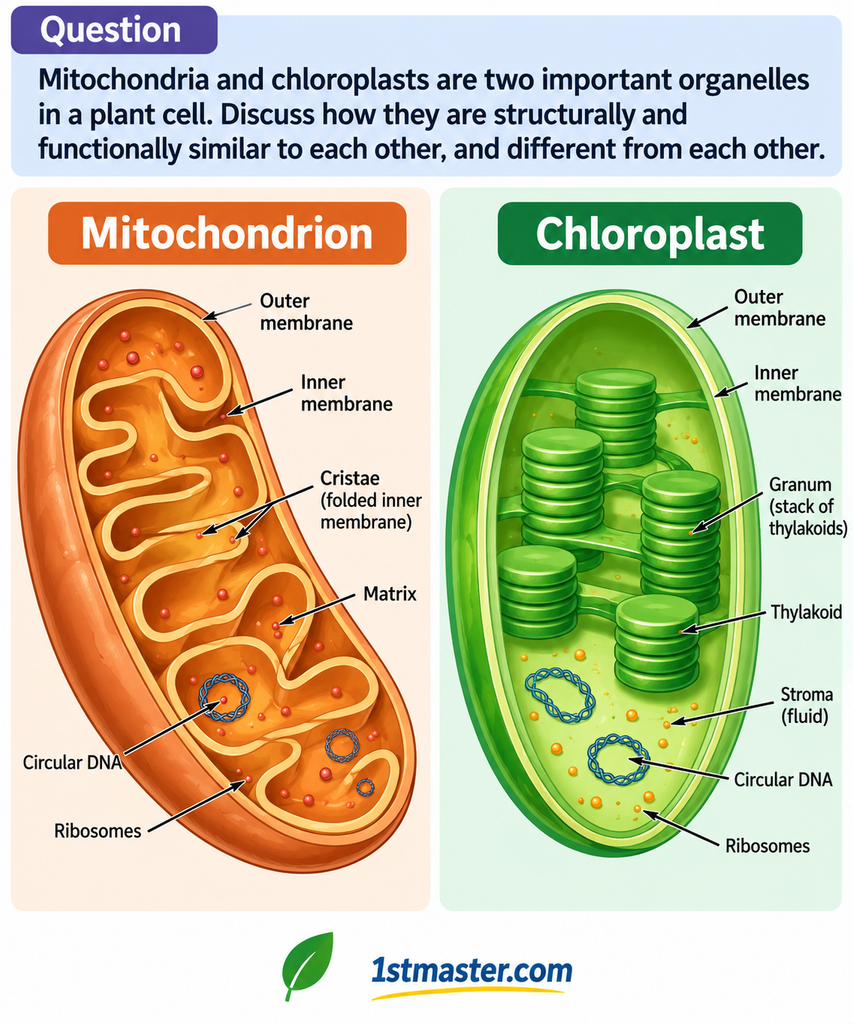
Mitochondria and chloroplasts are two important organelles in a plant cell. Discuss how they are structurally and functionally similar to each other, and different from each other.
Their similar structure and functions are:
Both Organelles, mitochondria and chloroplasts are double membrane-bound organelles and it contains their own DNA and ribosomes. They are involved in energy conversion. But their difference in structure and functionally are: Mitochondria have cristae but chloroplasts contain chlorophyll.
Mitochondria release energy from food through cellular respiration, but chloroplasts make foods by using photosynthesis and Store energy in the form of glucose .
What is Mitochondria
Mitochondria is a small and double bound membrane found in both animal and plant cell. It is also knows as powerhouse of the cell because it produce energy for the cell. It also make energy in the form of ATP as well as release energy in the during cellular respiration.
It has two membrane.
- Inner membrane – It is Smooth and protective.
- Outer membrane – It has a many irregular folded like structure called Cristea which is responsible for energy production.
What is Chloroplast
Chloroplast is a small organelles that is found in plant cell. It helps plant to make their own foods with the help of photosynthesis.
It contains a green pigment called chlorophyll which absorbs sunlight, plant use the sunlight, carbon dioxide and water to make their own foods and release oxygen as a by-product.