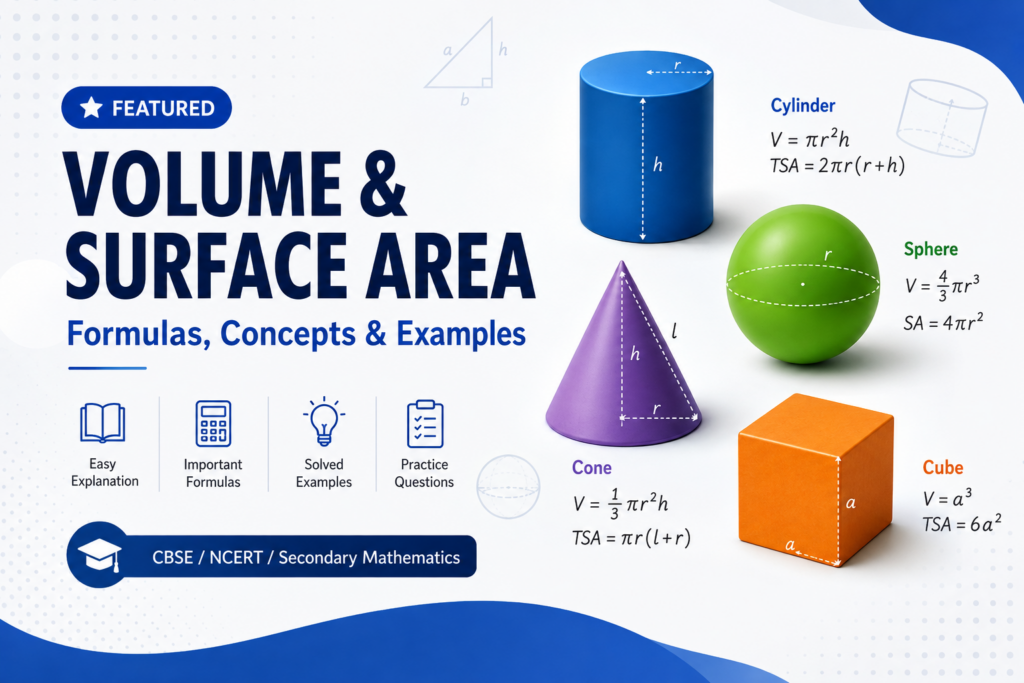
The volume and surface area are the important chapter of CBSE Board of Class 10. We are picking up most important question with solution and we also covered PYQ questions for that chapter so that our students can make such questions and get well in the examination.
A toy is in the form of a cone mounted on a hemisphere of radius 3.5 cm. The total height of the toy is 15.5 cm. Find the total surface area and volume of the toy. Take .
Answer
Given
A toy is made of a cone mounted on a hemisphere.
- Radius r=3.5 cm
- Total height = 15.5 cm
- π=722
Step 1: Height of the cone
Step 2: Slant height of the cone
Total Surface Area (TSA)
TSA = Curved surface area of hemisphere + Curved surface area of cone
The TSA of toy is 214.5 cm²
Volume of the toy
Volume = Volume of hemisphere + Volume of cone
Answer: 243.83 cm³ (approximately 243.8 cm³)
A toy is in the shape of a right circular cylinder with a hemisphere on one end and a cone on the other. The radius and height of the cylindrical part are 5 cm and 13 cm respectively. The radii of the hemispherical and conical parts are the same as that of the cylindrical part. Find the surface area of the toy, if the total height of the toy is 30 cm.
Answer
Step 1: Find the height of the cone
Given:
- Radius = 5 cm
- Height of cylinder = 13 cm
- Height of hemisphere = 5 cm
- Total height = 30 cm
Step 2: Find the slant height of the cone
Step 3: Total Surface Area
Only the curved surfaces are calculated.
Substitute the values:
Using
Total Surface Area = 770 cm²
An iron pillar has some part in the form of a right circular cylinder and the remaining part in the form of a right circular cone. The radius of the base of each of the cone and the cylinder is 8 cm. The cylindrical part is 240 cm high and the conical part is 36 cm high. Find the weight of the pillar if 1 cm³ of iron weighs 7.5 grams.
Answer
Given
| Quantity | Value |
|---|---|
| Radius (r) | 8 cm |
| Height of cylinder | 240 cm |
| Height of cone | 36 cm |
| Weight of 1 cm³ iron | 7.5 g |
Step 1: Volume of the pillar
Step 2: Weight of the pillar
Convert into kilograms:
Final Answer
Weight of the iron pillar = 380.16 kg
A gulabjamun, when ready for eating, contains sugar syrup of about 30% of its volume. Find approximately, how much syrup would be found in 45 such gulabjamuns, each shaped like a cylinder with two hemispherical ends, if the complete length of each of them is 5 cm and its diameter is 2.8 cm.
Given:
- Total length = 5 cm
- Diameter = 2.8 cm ⇒ Radius = 1.4 cm
- 45 gulabjamuns
- Syrup = 30% of volume
Step 1: Height of cylindrical part
Step 2: Volume of one gulabjamun
It consists of a cylinder and two hemispheres (= one sphere).
Using r=1.4 and h=2.2:
Step 3: Syrup in 45 gulabjamuns
Answer: 338 cm³ (approximately)
A toy is in the form of a cone mounted on a hemisphere of diameter 7 cm. The total height of the toy is 14.5 cm. Find the volume and the total surface area of the toy.
Answer
Given:
- Diameter = 7 cm ⇒ Radius = 3.5 cm
- Total height = 14.5 cm
- Cone height = 14.5 − 3.5 = 11 cm
Volume
Total Surface Area
Slant height:
Answer:
- Volume = 231 cm³
- Total Surface Area = 204 cm² (approx.)
A solid is composed of a cylinder with hemispherical ends. If the whole length of the solid is 98 cm and the diameter of each of its hemispherical ends is 28 cm, find the cost of polishing the surface of the solid at the rate of 15 paise per sq cm. Use
Answer
Given:
- Total length = 98 cm
- Diameter = 28 cm ⇒ Radius = 14 cm
- Cylinder height = 98 − 28 = 70 cm
Surface Area
Area of two hemispheres = Area of one sphere
Cost
Convert paisa to ruppes we know that 1 Paisa = ₹0.01
15 paise = ₹0.15
Answer: ₹1,293.60
From a solid cylinder whose height is 8 cm and radius 6 cm, a conical cavity of height 8 cm and base radius 6 cm is hollowed out. Find the volume of the remaining solid. Also, find the total surface area of the remaining solid. Take π = 3.14.
Given:
- Cylinder: Radius = 6 cm, Height = 8 cm
- Conical cavity: Radius = 6 cm, Height = 8 cm
- π = 3.14
Volume of Remaining Solid
Cylinder volume:
Cone volume:
Remaining volume:
Total Surface Area
Slant height:
Surface Area:
| Surface | Area (cm²) |
|---|---|
| Curved surface of cylinder | 301.44 |
| Bottom circular base | 113.04 |
| Curved surface of cone | 188.40 |
| Total | 602.88 |
Answer:
- Volume = 602.88 cm³
- Total Surface Area = 602.88 cm²
The internal and external diameters of a hollow hemispherical shell are 6 cm and 10 cm respectively. It is melted and recast into a solid cone of base diameter 14 cm. Find the height of the cone so formed.
Answer
Given:
- Internal diameter = 6 cm ⇒ r = 3 cm
- External diameter = 10 cm ⇒ R = 5 cm
- Cone radius = 7 cm
Solution
Volume of hollow hemispherical shell:
Volume of cone:
Equating volumes:
Answer: 4 cm
A solid metallic sphere of diameter 21 cm is melted and recast into a number of smaller cones, each of diameter 3.5 cm and height 3 cm. Find the number of cones so formed.
A solid metallic sphere of diameter 21 cm is melted and recast into smaller cones, each having diameter 3.5 cm and height 3 cm.
Given:
- Sphere radius = 10.5 cm
- Cone radius = 1.75 cm
- Cone height = 3 cm
Step 1: Volume of the sphere
Step 2: Volume of one cone
Step 3: Number of cones
Final Answer
504 cones can be formed.
A spherical ball of radius 3 cm is melted and recast into three spherical balls. The radii of two of these balls are 1.5 cm and 2 cm. Find the radius of the third ball.
Formula
Since the metal is melted, the total volume remains the same.
Cancel the common factor which is cancel out in both LHS and RHS. Then,
Final Answer
The radius of the third spherical ball is 2.5 cm.
A spherical ball of diameter 21 cm is melted and recast into cubes, each of side 1 cm. Find the number of cubes so formed.
A spherical ball of diameter 21 cm is melted and recast into cubes of side 1 cm.
Step 1: Radius of the sphere
Step 2: Volume of the sphere
Step 3: Volume of one cube
Step 4: Number of cubes
Final Answer: 4851 cubes
How many lead balls, each of radius 1 cm, can be made from a sphere of radius 8 cm?
A sphere of radius 8 cm is melted to make lead balls, each of radius 1 cm.
Formula
Volume of a sphere:
Since the metal is melted, the total volume remains the same.
Cancel the common terms:
Final Answer
512 lead balls can be made.
Marbles of diameter 1.4 cm are dropped into a cylindrical beaker of diameter 7 cm, containing some water. Find the number of marbles that should be dropped into the beaker so that the water level rises by 5.6 cm.
Marbles of diameter 1.4 cm are dropped into a cylindrical beaker of diameter 7 cm. The water level rises by 5.6 cm.
Given:
- Radius of marble = 0.7 cm
- Radius of beaker = 3.5 cm
- Rise in water level = 5.6 cm
Step 1: Volume of water displaced
The rise in water level equals the volume of the marbles.
Step 2: Volume of one marble
Step 3: Number of marbles
Final Answer
150 marbles should be dropped into the beaker.