Triangle Class 10 Important Question PYQ

Welcome Back, Today i will provide you top best important question of Triangle Chapter of class 10. Those question are already asked in previous Year of CBSE Board.

Question

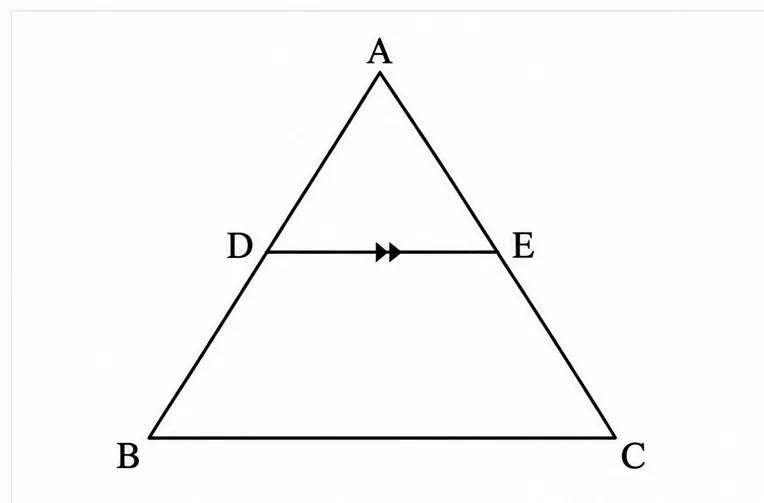
In the given figure, DEBCDE\parallel BC and ADDB=35\frac{AD}{DB}=\frac35. If AC=4.8AC=4.8 cm, find the length of AEAE.

Answer

Solution:
Let AE=xAE=x cm.

ThenEC=ACAE=4.8xEC=AC-AE=4.8-x

Since DEBCDE\parallel BC, by Thales’ theorem,ADDB=AEEC\frac{AD}{DB}=\frac{AE}{EC}35=x4.8x\frac35=\frac{x}{4.8-x}3(4.8x)=5x3(4.8-x)=5x14.43x=5x14.4-3x=5x8x=14.48x=14.4x=1.8\boxed{x=1.8}

Therefore, AE=1.8 cm​

Question

In ABC\triangle ABC, DEBCDE\parallel BC, such thatAD=(4x3) cm,AE=(8x7) cm,AD=(4x-3)\text{ cm},\quad AE=(8x-7)\text{ cm},BD=(3x1) cm,CE=(5x3) cm.BD=(3x-1)\text{ cm},\quad CE=(5x-3)\text{ cm}.

Find the value of xx.

Answer

By Thales’ theorem,ADBD=AECE\frac{AD}{BD}=\frac{AE}{CE}

Therefore,4x33x1=8x75x3\frac{4x-3}{3x-1} = \frac{8x-7}{5x-3}

Cross-multiplying,(4x3)(5x3)=(3x1)(8x7)(4x-3)(5x-3)=(3x-1)(8x-7)20x227x+9=24x229x+720x^2-27x+9=24x^2-29x+74x22x2=04x^2-2x-2=02x2x1=02x^2-x-1=0(2x+1)(x1)=0(2x+1)(x-1)=0

So,x=1orx=12x=1\quad\text{or}\quad x=-\frac12

Since a length cannot be negative, x=1​

Question

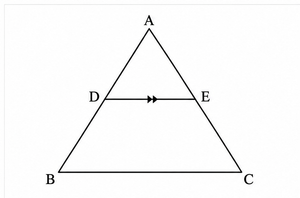
In the adjoining figure, DEBCDE\parallel BC. If AD=1.7AD=1.7 cm, AB=6.8AB=6.8 cm and AC=9AC=9 cm, find AEAE.

Answer

Solution:

By Thales’ theorem,ADAB=AEAC\frac{AD}{AB}=\frac{AE}{AC}1.76.8=AE9\frac{1.7}{6.8}=\frac{AE}{9}

Therefore,AE=1.7×96.8AE=\frac{1.7\times9}{6.8}AE=2.25AE=2.25

Hence, AE=2.25 cm​

Question

If DD and EE are points on the sides ABAB and ACAC, respectively, of ABC\triangle ABC, such thatAB=5.6 cm,AD=1.4 cm,AB=5.6\text{ cm},\quad AD=1.4\text{ cm},AC=7.2 cm,AE=1.8 cm,AC=7.2\text{ cm},\quad AE=1.8\text{ cm},

show that DEBCDE\parallel BC.

Answer

Solution:ADAB=1.45.6=14\frac{AD}{AB} = \frac{1.4}{5.6} = \frac14

andAEAC=1.87.2=14\frac{AE}{AC} = \frac{1.8}{7.2} = \frac14

Therefore,ADAB=AEAC\frac{AD}{AB}=\frac{AE}{AC}

Hence, by the converse of Thales’ theorem, DE∥BC​

Question

In the given figure,ADDB=AEEC\frac{AD}{DB}=\frac{AE}{EC}

and ADE=ACB\angle ADE=\angle ACB. Prove that ABC\triangle ABC is an isosceles triangle.

Answer

Solution:

Given,ADDB=AEEC\frac{AD}{DB}=\frac{AE}{EC}

Therefore, by the converse of Thales’ theorem,DEBCDE\parallel BC

Hence,ADE=ABC\angle ADE=\angle ABC

because they are corresponding angles.

But given,ADE=ACB\angle ADE=\angle ACB

Therefore,ABC=ACB\angle ABC=\angle ACB

Angles opposite equal sides are equal, soAB=ACAB=AC

Hence, △ABC is an isosceles triangle​

Question

Question:
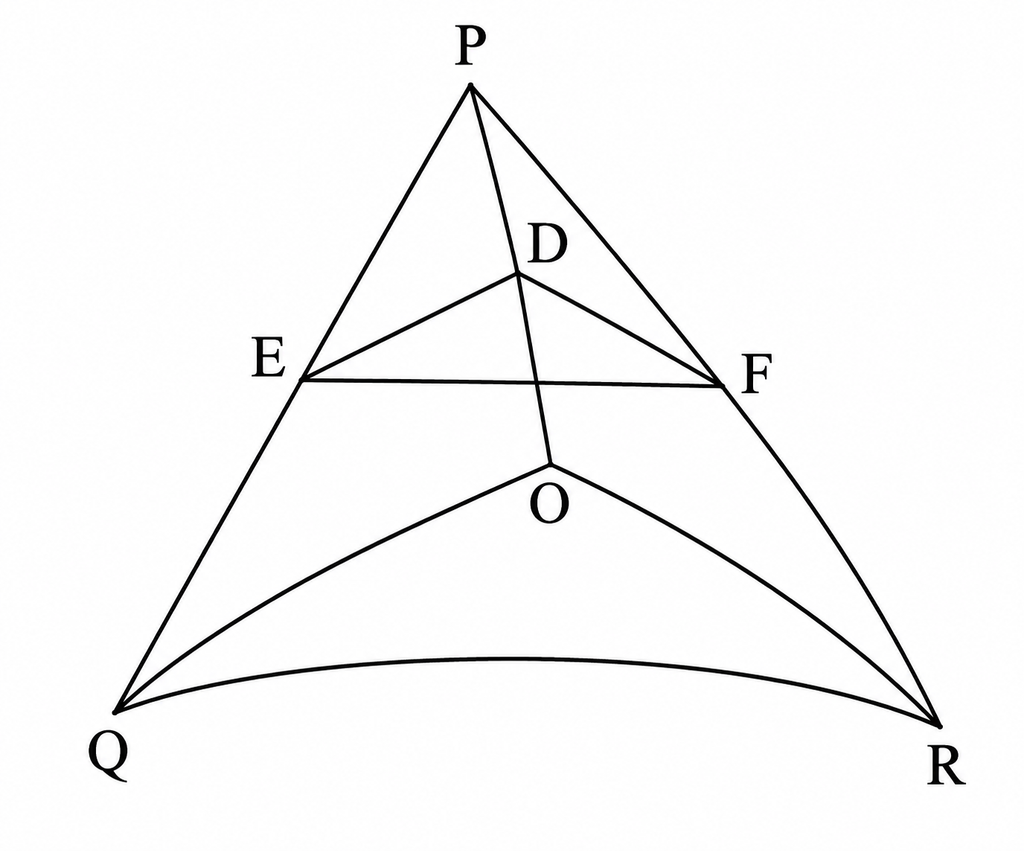
In the given figure, DEOQDE\parallel OQ and DFORDF\parallel OR. Show that EFQREF\parallel QR.

Answer

In ΔPOQ, DE || OQ.

PDDO=PEEQ...(i)[by Thales’ theorem]\frac{PD}{DO}=\frac{PE}{EQ} \qquad …(i)\quad [\text{by Thales’ theorem}]

In ΔPOR, DF || OR.

PDDO=PFFR...(ii)\frac{PD}{DO}=\frac{PF}{FR} \qquad …(ii)

From (i) and (ii), we get:PEEQ=PFFR[each equal to PDDO].\frac{PE}{EQ}=\frac{PF}{FR} \qquad \left[\text{each equal to }\frac{PD}{DO}\right].

Thus, in ΔPQR, E and F are points on PQ and PR respectively such thatPEEQ=PFFR.\frac{PE}{EQ}=\frac{PF}{FR}.

Hence, EF || QR [by the converse of Thales’ theorem].

Question

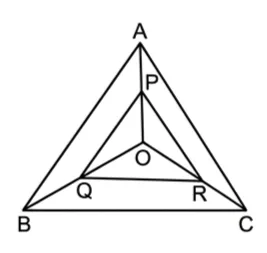
In the given figure, PQABPQ\parallel AB and PRACPR\parallel AC. Prove that QRBCQR\parallel BC.

Answer

SOLUTION

In ΔOAB, PQ || AB.

OPPA=OQQB...(i)[by the Thales’ theorem]\frac{OP}{PA}=\frac{OQ}{QB} \qquad …(i)\quad [\text{by the Thales’ theorem}]

In ΔAOC, PR || AC.

OPPA=ORRC...(ii)[by Thales’ theorem]\frac{OP}{PA}=\frac{OR}{RC} \qquad …(ii)\quad [\text{by Thales’ theorem}]

From (i) and (ii), we get:OQQB=ORRCin ΔOBC.\frac{OQ}{QB}=\frac{OR}{RC} \quad\text{in ΔOBC}.

Thus, in ΔOBC, O and R are points on OB and OC respectively such thatOQQB=ORRC.\frac{OQ}{QB}=\frac{OR}{RC}.

Hence, by the converse of Thales’ theorem, QR || BC.

Question

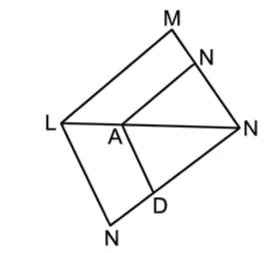
In the given figure, LM || CB and LN || CD.
Prove thatAMAB=ANAD.\frac{AM}{AB}=\frac{AN}{AD}.

Answer

SOLUTION

In ΔALM, LM || CB.ABAM=ACALAMAB=ALAC...(i)\therefore\quad \frac{AB}{AM}=\frac{AC}{AL} \Rightarrow \frac{AM}{AB}=\frac{AL}{AC} \qquad …(i)

In ΔALN, LN || CD.ACAL=ADANALAC=ANAD...(ii)\therefore\quad \frac{AC}{AL}=\frac{AD}{AN} \Rightarrow \frac{AL}{AC}=\frac{AN}{AD} \qquad …(ii)

From (i) and (ii), we get:AMAB=ANAD.\boxed{\frac{AM}{AB}=\frac{AN}{AD}}.

Question

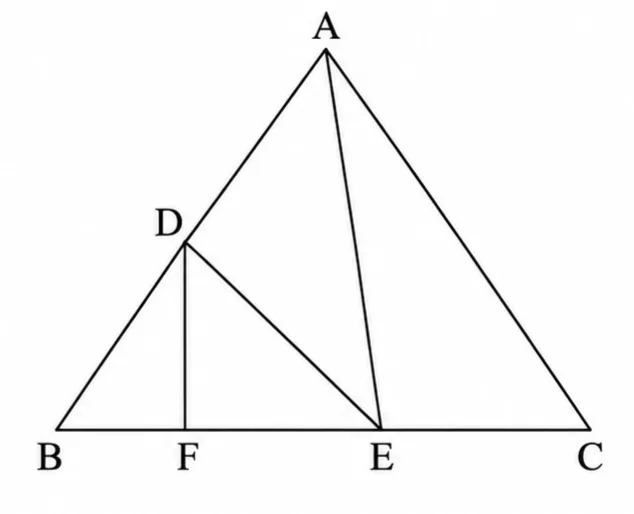
In the given figure, DE || AC and DF || AE.
Prove thatBFFE=BEEC.\frac{BF}{FE}=\frac{BE}{EC}.

Answer

In ΔBAE, DF || AE.BDDA=BFFE...(i)[by Thales’ theorem]\therefore\quad \frac{BD}{DA}=\frac{BF}{FE} \qquad …(i)\quad [\text{by Thales’ theorem}]

In ΔBAC, DE || AC.BDDA=BEEC...(ii)[by Thales’ theorem]\therefore\quad \frac{BD}{DA}=\frac{BE}{EC} \qquad …(ii)\quad [\text{by Thales’ theorem}]

From (i) and (ii), we get:BFFE=BEEC[each equal to BDDA].\frac{BF}{FE}=\frac{BE}{EC} \qquad \left[\text{each equal to }\frac{BD}{DA}\right].

Question

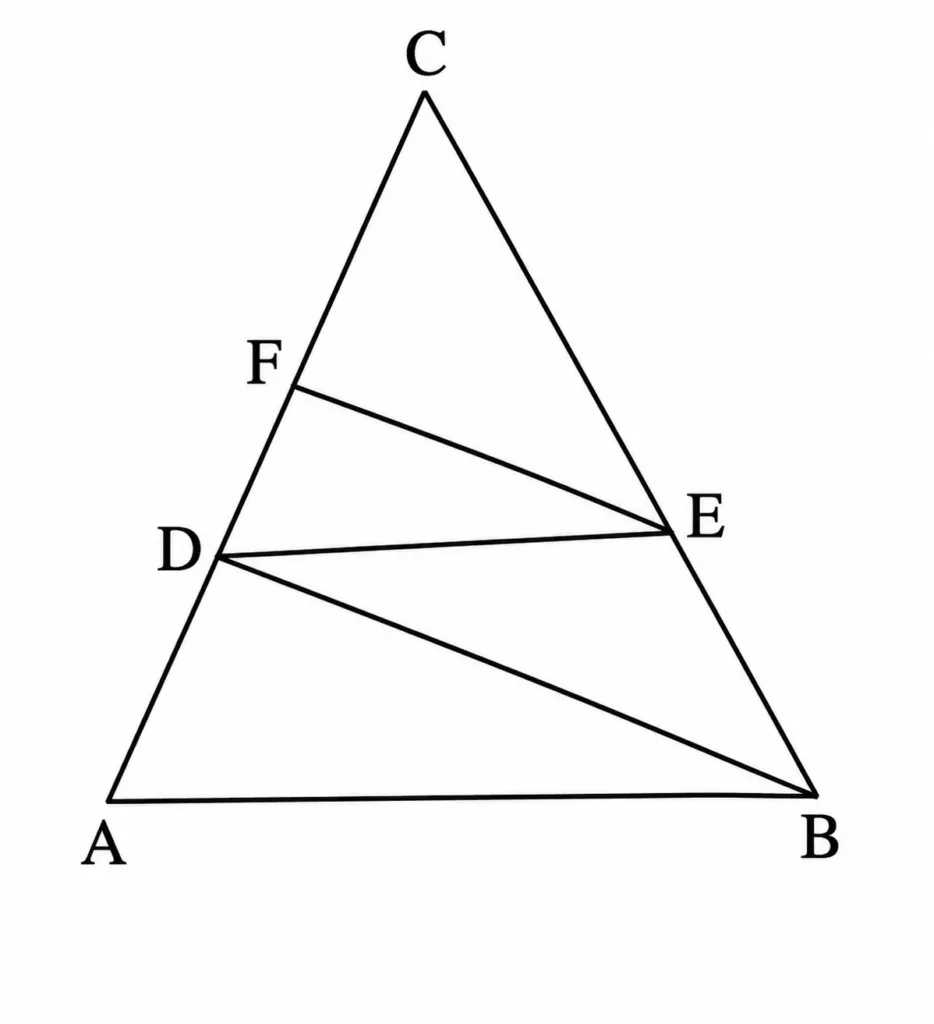
In the given figure, AB || DE and BD || EF.
Prove that DC2=CF×AC.
Answer

SOLUTION

In ΔABC, AB || DE.CDDA=CEEB...(i)[by Thales’ theorem]\therefore\quad \frac{CD}{DA}=\frac{CE}{EB} \qquad …(i)\quad [\text{by Thales’ theorem}]

In ΔCDB, BD || EF.CFFD=CEEB...(ii)[by Thales’ theorem]\therefore\quad \frac{CF}{FD}=\frac{CE}{EB} \qquad …(ii)\quad [\text{by Thales’ theorem}]

From (i) and (ii), we get:CDDA=CFFD\frac{CD}{DA}=\frac{CF}{FD}DADC=FDCF[taking reciprocals]\Rightarrow\quad \frac{DA}{DC}=\frac{FD}{CF} \qquad [\text{taking reciprocals}]DADC+1=FDCF+1\Rightarrow\quad \frac{DA}{DC}+1=\frac{FD}{CF}+1DA+DCDC=FD+CFCF\Rightarrow\quad \frac{DA+DC}{DC}=\frac{FD+CF}{CF}ACDC=DCCF\Rightarrow\quad \frac{AC}{DC}=\frac{DC}{CF} ⇒DC2=CF×AC​.

Question

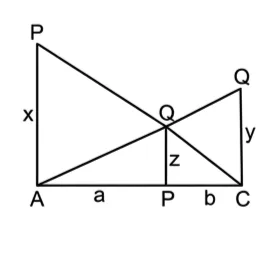
In the given figure PA, QB and RC each is perpendicular to AC such thatPA=x,RC=y,QB=z,AB=aPA=x,\quad RC=y,\quad QB=z,\quad AB=a

andBC=b.BC=b.

Prove that1x+1y=1z.\frac1x+\frac1y=\frac1z.

Answer

SOLUTIONPAAC and QBACQBPA.PA\perp AC\text{ and }QB\perp AC \Rightarrow QB\parallel PA.

Thus, in ΔPAC, QB || PA. So, ΔQBC ∼ ΔPAC.QBPA=BCACzx=ba+b...(i)[by the property of similar ]\therefore\quad \frac{QB}{PA}=\frac{BC}{AC} \Rightarrow \frac{z}{x}=\frac{b}{a+b} \qquad …(i)\quad [\text{by the property of similar }\triangle]

In ΔRAC, QB || RC. So, ΔQBC ∼ ΔRAC.QBRC=ABACzy=aa+b...(ii)[by the property of similar ]\therefore\quad \frac{QB}{RC}=\frac{AB}{AC} \Rightarrow \frac{z}{y}=\frac{a}{a+b} \qquad …(ii)\quad [\text{by the property of similar }\triangle]

From (i) and (ii), we get:zx+zy=(ba+b+aa+b)=1\frac{z}{x}+\frac{z}{y} = \left(\frac{b}{a+b}+\frac{a}{a+b}\right)=1zx+zy=1\Rightarrow\quad \frac{z}{x}+\frac{z}{y}=1you can show the steps clearly by taking z common:z(1x+1y)=1\Rightarrow z\left(\frac{1}{x}+\frac{1}{y}\right)=11x+1y=1z[dividing both sides by z]\Rightarrow \frac{1}{x}+\frac{1}{y}=\frac{1}{z} \qquad [\text{dividing both sides by }z]

Question

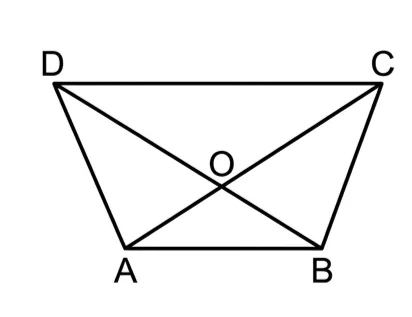
ABCD is a trapezium with ABDCAB\parallel DC.
E and F are points on non-parallel sides ADAD and BCBC respectively such that EFABEF\parallel AB. Show thatAEED=BFFC.\frac{AE}{ED}=\frac{BF}{FC}.

Answer

SOLUTION

GIVEN A trap. ABCDABCD in which ABDCAB\parallel DC. E and F are points on ADAD and BCBC respectively such that EFABEF\parallel AB.

TO PROVEAEED=BFFC.\frac{AE}{ED}=\frac{BF}{FC}.

CONSTRUCTION Join ACAC, intersecting EFEF at GG.

PROOF EFABEF\parallel AB and ABDCEFDCAB\parallel DC\Rightarrow EF\parallel DC.

Now, in ADC\triangle ADC, EGDCEG\parallel DC.AEED=AGGC...(i)[by Thales’ theorem]\therefore\quad \frac{AE}{ED}=\frac{AG}{GC} \qquad …(i)\quad [\text{by Thales’ theorem}]

Similarly, in CAB\triangle CAB, GFABGF\parallel AB.AGGC=BFFC...(ii)[GCAG=FCBF by Thales’ theorem]\therefore\quad \frac{AG}{GC}=\frac{BF}{FC} \qquad …(ii)\quad \left[\therefore\frac{GC}{AG}=\frac{FC}{BF}\text{ by Thales’ theorem}\right]

From (i) and (ii), we get: EDAE​=FCBF​​.

Question

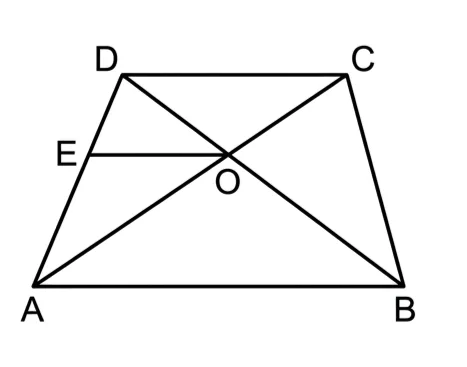
ABCD is a trapezium in which ABDCAB\parallel DC and its diagonals intersect each other at the point O.

Prove thatAOOC=BOOD.\frac{AO}{OC}=\frac{BO}{OD}.

Answer

SOLUTION

GIVEN A trapezium ABCDABCD in which ABDCAB\parallel DC and its diagonals ACAC and BDBD intersect at O.

TO PROVEAOOC=BOOD.\frac{AO}{OC}=\frac{BO}{OD}.

CONSTRUCTION Through O, draw EOABEO\parallel AB, meeting ADAD at E.

PROOF In ADC\triangle ADC, EODCEO\parallel DC
[EOABDC][\therefore EO\parallel AB\parallel DC]AEED=AOOC...(i)[by Thales’ theorem]\therefore\quad \frac{AE}{ED}=\frac{AO}{OC} \qquad …(i)\quad [\text{by Thales’ theorem}]

In DAB\triangle DAB, EOABEO\parallel AB.AEED=BOOD...(ii)\therefore\quad \frac{AE}{ED}=\frac{BO}{OD} \qquad …(ii)From (i) and (ii), we get:\text{From (i) and (ii), we get:}AOOC=BOOD.\boxed{\frac{AO}{OC}=\frac{BO}{OD}}.

Question

The diagonals of a quadrilateral ABCDABCD intersect each other at the point O such thatAOOC=BOOD.\frac{AO}{OC}=\frac{BO}{OD}.

Show that ABCDABCD is a trapezium.

Answer

SOLUTION

GIVEN A quadrilateral ABCDABCD whose diagonals ACAC and BDBD intersect at a point O such thatAOOC=BOOD.\frac{AO}{OC}=\frac{BO}{OD}.

TO PROVE ABCDABCD is a trapezium, i.e., ABDCAB\parallel DC.

CONSTRUCTION Draw EODCEO\parallel DC, meeting ADAD at E.

PROOF In ACD\triangle ACD, EODCEO\parallel DC.AOOC=AEED...(i)[by Thales’ theorem]\therefore\quad \frac{AO}{OC}=\frac{AE}{ED} \qquad …(i)\quad [\text{by Thales’ theorem}]

But,AOOC=BOOD(given)\frac{AO}{OC}=\frac{BO}{OD}\quad\text{(given)}BOOD=AEEDin DAB.\therefore\quad \frac{BO}{OD}=\frac{AE}{ED} \quad\text{in }\triangle DAB.

So, EOABEO\parallel AB [by the converse of Thales’ theorem].

But, EODCEO\parallel DC.

Hence,ABDC.\boxed{AB\parallel DC}.

Question

In the given figure, ABCDABCD is a trapezium in which ABDCAB\parallel DC and its diagonals intersect at O. IfAO=(3x1) cm,OC=(5x3) cm,AO=(3x-1)\text{ cm},\quad OC=(5x-3)\text{ cm},BO=(2x+1) cm and OD=(6x5) cm,BO=(2x+1)\text{ cm and }OD=(6x-5)\text{ cm},

find the value of xx.

Answer

SOLUTION

We know that ABDCAB\parallel DC in trap. ABCDABCD and its diagonals intersect at O. Then, we have:AOOC=BOOD3x15x3=2x+16x5\frac{AO}{OC}=\frac{BO}{OD} \Rightarrow \frac{3x-1}{5x-3}=\frac{2x+1}{6x-5}(3x1)(6x5)=(2x+1)(5x3)\Rightarrow (3x-1)(6x-5)=(2x+1)(5x-3)18x221x+5=10x2x3\Rightarrow 18x^2-21x+5=10x^2-x-38x220x+8=0\Rightarrow 8x^2-20x+8=02x25x+2=0\Rightarrow 2x^2-5x+2=0(x2)(2x1)=0\Rightarrow (x-2)(2x-1)=0x=2 or x=12.\Rightarrow x=2\text{ or }x=\frac12.

But, x=12x=\frac12 will makeOC=(5x3) cm=(5×123) cmOC=(5x-3)\text{ cm} =\left(5\times\frac12-3\right)\text{ cm}=12 cm.=-\frac12\text{ cm}.

And, the distance cannot be negative.x12.\therefore\quad x\ne\frac12.

Hence, x=2​.

How useful was this post?

Click on a star to rate it!

Average rating 5 / 5. Vote count: 1

No votes so far! Be the first to rate this post.

Leave a Comment

Your email address will not be published. Required fields are marked *

Scroll to Top