Welcome Back, Today i will provide you top best important question of Triangle Chapter of class 10. Those question are already asked in previous Year of CBSE Board.
In the given figure, and . If cm, find the length of .
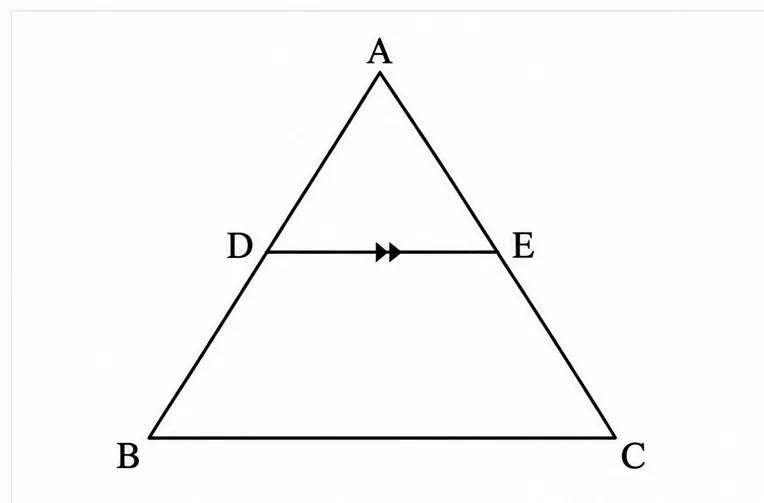
Solution:
Let cm.
Then
Since , by Thales’ theorem,
Therefore, AE=1.8 cm
In , , such that
Find the value of .
By Thales’ theorem,
Therefore,
Cross-multiplying,
So,
Since a length cannot be negative, x=1
In the adjoining figure, . If cm, cm and cm, find .
Solution:
By Thales’ theorem,
Therefore,
Hence, AE=2.25 cm
If and are points on the sides and , respectively, of , such that
show that .
Solution:
and
Therefore,
Hence, by the converse of Thales’ theorem, DE∥BC
In the given figure,
and . Prove that is an isosceles triangle.
Solution:
Given,
Therefore, by the converse of Thales’ theorem,
Hence,
because they are corresponding angles.
But given,
Therefore,
Angles opposite equal sides are equal, so
Hence, △ABC is an isosceles triangle
Question:
In the given figure, and . Show that .
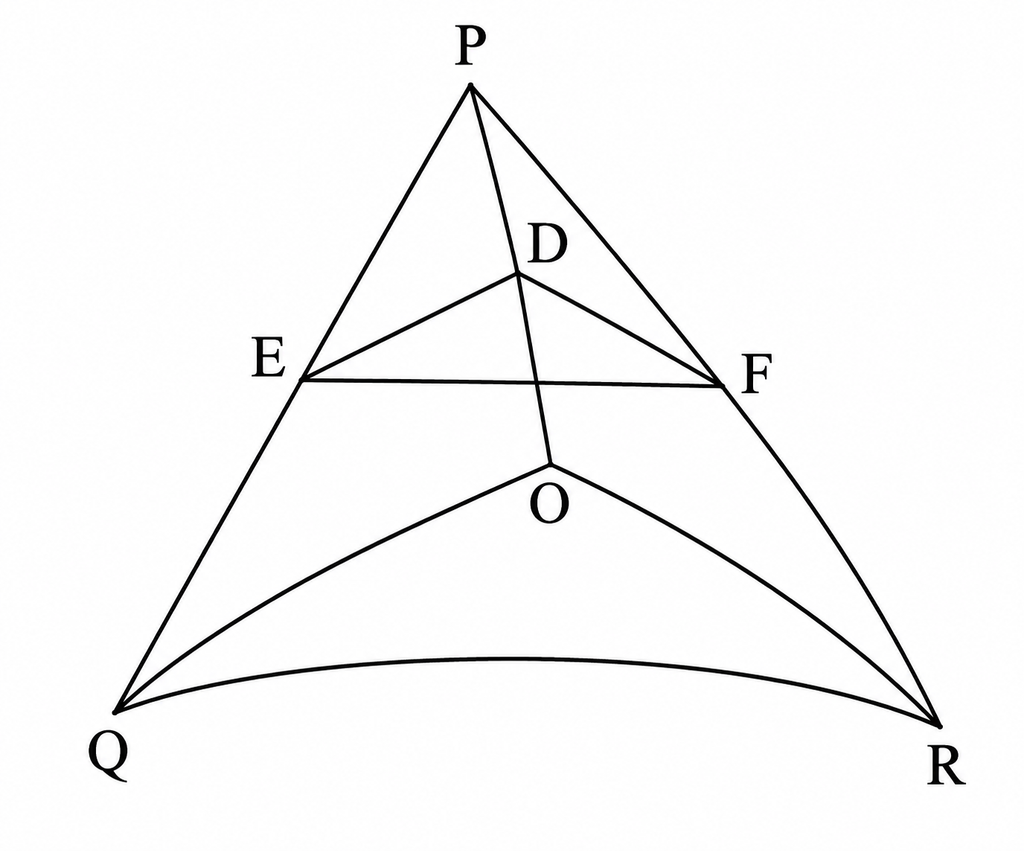
In ΔPOQ, DE || OQ.
∴
In ΔPOR, DF || OR.
∴
From (i) and (ii), we get:
Thus, in ΔPQR, E and F are points on PQ and PR respectively such that
Hence, EF || QR [by the converse of Thales’ theorem].
In the given figure, and . Prove that .
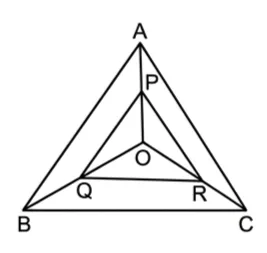
SOLUTION
In ΔOAB, PQ || AB.
∴
In ΔAOC, PR || AC.
∴
From (i) and (ii), we get:
Thus, in ΔOBC, O and R are points on OB and OC respectively such that
Hence, by the converse of Thales’ theorem, QR || BC.
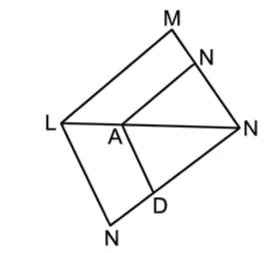
In the given figure, LM || CB and LN || CD.
Prove that
SOLUTION
In ΔALM, LM || CB.
In ΔALN, LN || CD.
From (i) and (ii), we get:
In the given figure, DE || AC and DF || AE.
Prove that
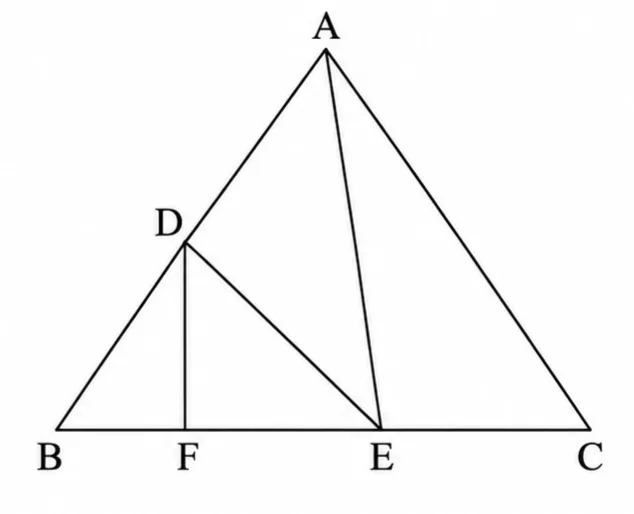
In ΔBAE, DF || AE.
In ΔBAC, DE || AC.
From (i) and (ii), we get:
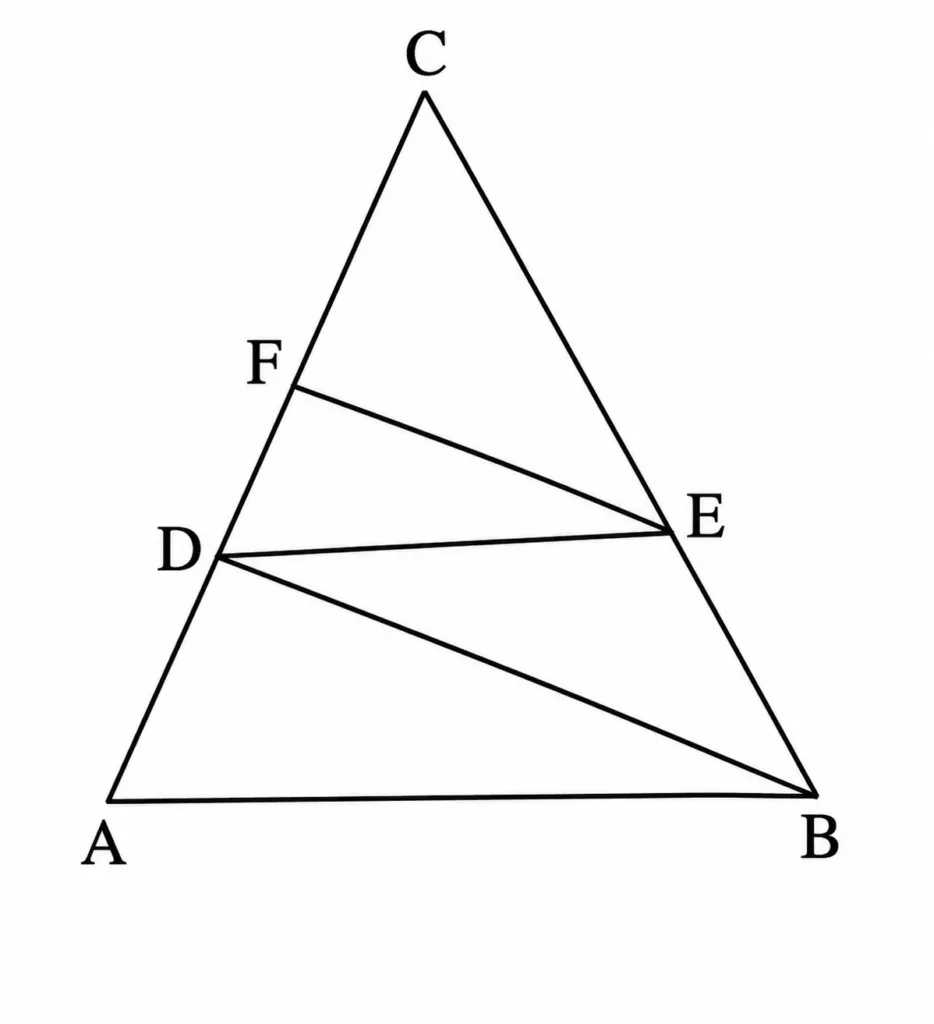
In the given figure, AB || DE and BD || EF.
Prove that DC2=CF×AC.
SOLUTION
In ΔABC, AB || DE.
In ΔCDB, BD || EF.
From (i) and (ii), we get: ⇒DC2=CF×AC.
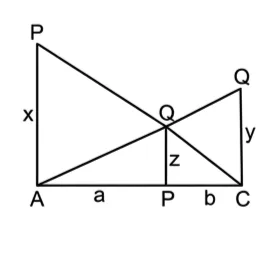
In the given figure PA, QB and RC each is perpendicular to AC such that
and
Prove that
SOLUTION
Thus, in ΔPAC, QB || PA. So, ΔQBC ∼ ΔPAC.
In ΔRAC, QB || RC. So, ΔQBC ∼ ΔRAC.
From (i) and (ii), we get:you can show the steps clearly by taking z common:
ABCD is a trapezium with .
E and F are points on non-parallel sides and respectively such that . Show that
SOLUTION
GIVEN A trap. in which . E and F are points on and respectively such that .
TO PROVE
CONSTRUCTION Join , intersecting at .
PROOF and .
Now, in , .
Similarly, in , .
From (i) and (ii), we get: EDAE=FCBF.
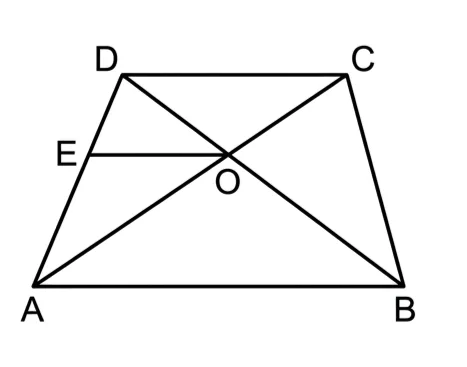
ABCD is a trapezium in which and its diagonals intersect each other at the point O.
Prove that
SOLUTION
GIVEN A trapezium in which and its diagonals and intersect at O.
TO PROVE
CONSTRUCTION Through O, draw , meeting at E.
PROOF In ,
In , .
The diagonals of a quadrilateral intersect each other at the point O such that
Show that is a trapezium.
SOLUTION
GIVEN A quadrilateral whose diagonals and intersect at a point O such that
TO PROVE is a trapezium, i.e., .
CONSTRUCTION Draw , meeting at E.
PROOF In , .
But,
So, [by the converse of Thales’ theorem].
But, .
Hence,
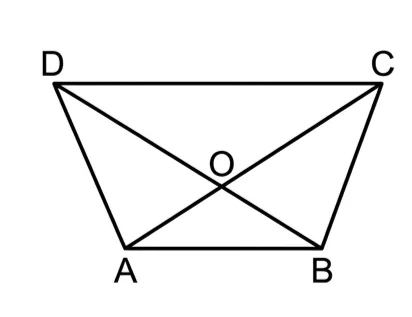
In the given figure, is a trapezium in which and its diagonals intersect at O. If
find the value of .
SOLUTION
We know that in trap. and its diagonals intersect at O. Then, we have:
But, will make
And, the distance cannot be negative.
Hence, x=2.